Cybersecurity Reference > Glossary
What is Runtime Security?





Unlike static security measures that analyze code before deployment, runtime security monitors applications in real-time to detect and prevent threats as they occur during program execution. Think of it as having a security guard watching over your application every moment it's running, rather than just checking it once at the door.
Runtime security solutions employ behavioral analysis, anomaly detection, and continuous monitoring to identify malicious activities such as code injection attacks, buffer overflows, unauthorized API calls, and privilege escalation attempts. These tools can automatically block suspicious operations, quarantine affected processes, or alert security teams to potential threats. Key components include runtime application self-protection (RASP), which embeds security controls directly into applications, and runtime monitoring that observes application behavior for deviations from expected patterns.
This approach is particularly valuable because it can detect zero-day exploits and previously unknown attack vectors that static analysis might miss. Runtime security provides continuous protection throughout an application's lifecycle, ensuring that security remains effective even as code is updated or as new threats emerge during operation. In modern cloud-native environments where applications are dynamically deployed and scaled, runtime security has become essential because traditional perimeter-based defenses no longer suffice.
Origin
Early runtime security techniques borrowed from operating system memory protection mechanisms and dynamic analysis tools used in software development. As web applications proliferated in the mid-2000s, the attack surface expanded dramatically. Developers realized that static code analysis couldn't catch every vulnerability, especially those that emerged from complex interactions between different system components or unpredictable user inputs.
The rise of cloud computing and containerization in the 2010s accelerated runtime security's evolution. Applications began running in increasingly dynamic and distributed environments where traditional security boundaries dissolved. This shift made runtime protection not just helpful but necessary. RASP emerged as a distinct category around 2012, embedding security directly into application runtime environments rather than relying solely on external monitoring.
The growth of DevOps and continuous deployment practices further emphasized runtime security's importance. When applications update constantly and deploy across diverse environments, the runtime becomes the only consistent point where security controls can reliably operate.
Why It Matters
The stakes are particularly high in cloud-native architectures. Microservices communicate across network boundaries, containers spin up and down dynamically, and serverless functions execute in environments you don't control. Attackers exploit this complexity, using techniques like memory manipulation, deserialization attacks, and API abuse that only work against running applications. By the time you discover a vulnerability through traditional means, attackers may have already exploited it thousands of times.
Runtime security also matters because it catches zero-day exploits. When attackers discover a vulnerability before vendors do, runtime monitoring can detect the abnormal behavior even without knowing the specific attack signature. This behavioral approach provides protection against both known and unknown threats.
For organizations embracing DevOps and rapid deployment cycles, runtime security offers continuous protection without slowing down releases. Rather than gate deployments with lengthy security reviews, runtime controls provide a safety net that lets development teams move fast while maintaining security.
The Plurilock Advantage
Our approach combines application security testing with ongoing monitoring, giving you both prevention and detection. We help you implement controls that make sense for your environment, whether you're securing legacy applications or cloud-native microservices. Learn more about our application and API testing services to strengthen your runtime security posture.
.
Ready to Strengthen Your Runtime Security?
Plurilock's runtime protection solutions defend applications during live execution against advanced threats.
Get Runtime Protection Now → Learn more →Downloadable References

Sample Governance Policy for AI Use
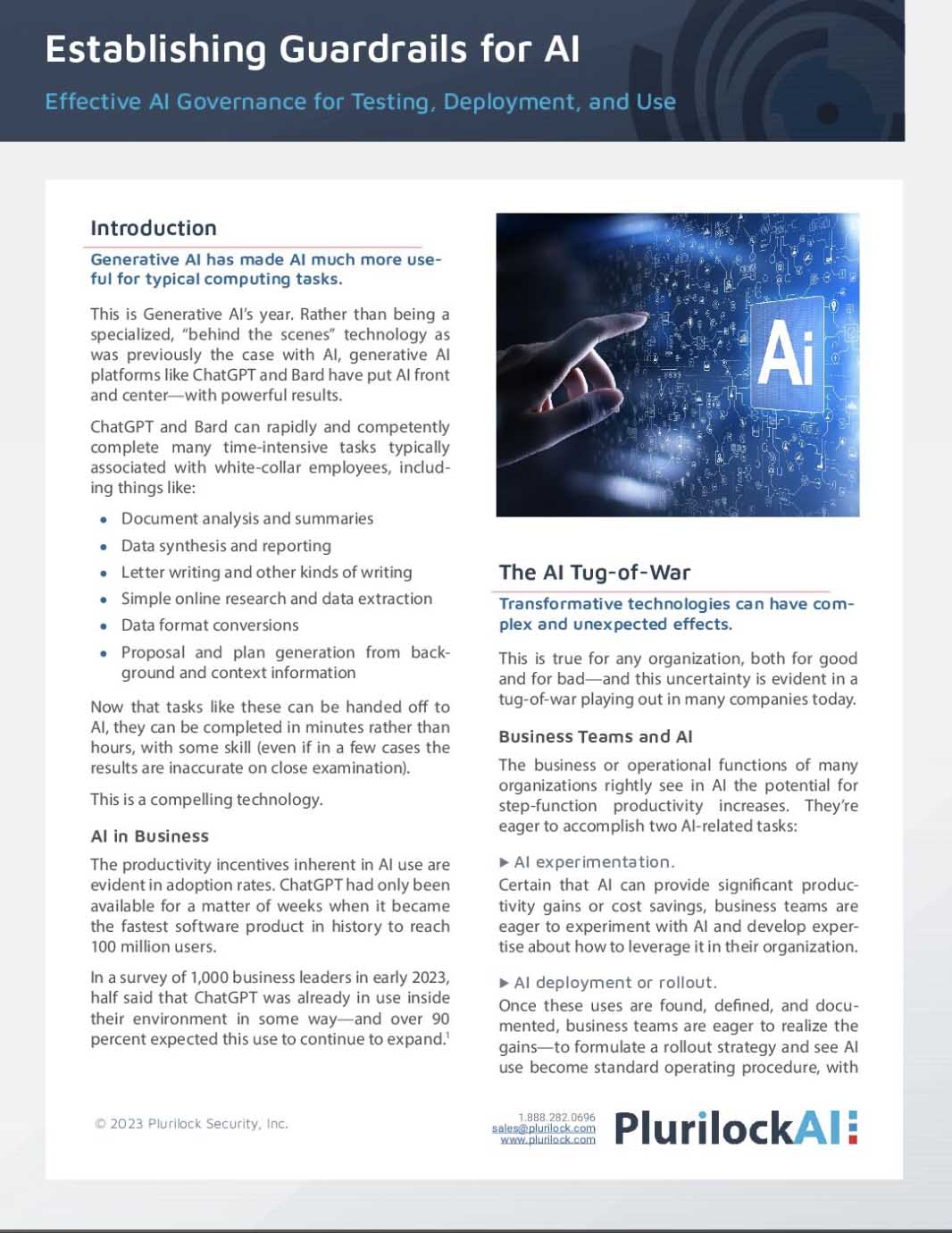
Establishing Guardrails for AI Whitepaper