Cybersecurity Reference > Glossary
What is Data Encryption?





Think of it like putting a message in a safe—without the combination, the contents stay hidden even if someone steals the safe itself. The readable version is called plaintext, and the scrambled version is ciphertext.
Two main approaches handle most encryption work. Symmetric encryption uses a single key for both locking and unlocking data, like AES (Advanced Encryption Standard), which is fast and efficient for protecting large amounts of stored information. Asymmetric encryption uses a pair of keys—one public, one private—and powers technologies like RSA, which secures everything from email to website connections. The strength of encryption depends largely on key length; a 256-bit key offers vastly more protection than a 128-bit one.
Organizations encrypt data both at rest (sitting on hard drives or in databases) and in transit (moving across networks). This protects sensitive information even if attackers breach perimeter defenses or intercept network traffic. Regulatory standards like GDPR, HIPAA, and PCI DSS frequently require encryption for personal data, health records, and payment information, making it both a technical safeguard and a compliance necessity.
Origin
The digital age demanded new approaches. In the 1970s, IBM developed DES (Data Encryption Standard), which became the first widely adopted commercial encryption algorithm. More importantly, Whitfield Diffie and Martin Hellman published their concept of public-key cryptography in 1976, solving a problem that had plagued secret communication for centuries: how to share encryption keys securely. Their work, along with the RSA algorithm developed shortly after, made secure communication possible between parties who had never met.
By the 1990s, encryption became central to internet commerce and privacy. The development of AES in 2001 provided a stronger successor to DES, and widespread adoption of SSL/TLS protocols brought encryption to everyday web browsing. What was once military technology became infrastructure. The emergence of quantum computing now threatens many current encryption methods, pushing cryptographers to develop post-quantum algorithms that can withstand attacks from machines that don't yet exist at scale.
Why It Matters
The threat landscape makes encryption more critical than ever. Ransomware attacks encrypt victim data with military-grade algorithms, demonstrating both encryption's power and how easily it can become a weapon. Data breaches expose billions of records annually, but encrypted data remains largely useless to attackers who lack decryption keys. This gap between stolen and exploitable data often determines whether a breach becomes a catastrophe or a manageable incident.
Compliance requirements increasingly mandate encryption, but implementation reveals complexity. Key management becomes a single point of failure—lose the keys, lose the data permanently. Organizations struggle with performance impacts, especially when encrypting databases or real-time communications. The rise of cloud computing adds layers of confusion about who controls encryption keys and whether cloud providers can access encrypted data. Post-quantum cryptography looms as an approaching deadline; systems encrypted with today's standards may become vulnerable once quantum computers mature. Organizations must balance current protection with future readiness, encrypting data that might sit in backups for years.
The Plurilock Advantage
We assess your current encryption posture, identify gaps, and implement solutions that meet both regulatory requirements and real-world threat scenarios. This includes post-quantum cryptography readiness assessments that prepare your organization for the next generation of threats. Learn more about our data loss prevention and data protection services.
.
Need Advanced Data Encryption Solutions?
Plurilock's encryption services protect your sensitive data with enterprise-grade security measures.
Secure My Data Now → Learn more →Downloadable References

Sample Governance Policy for AI Use
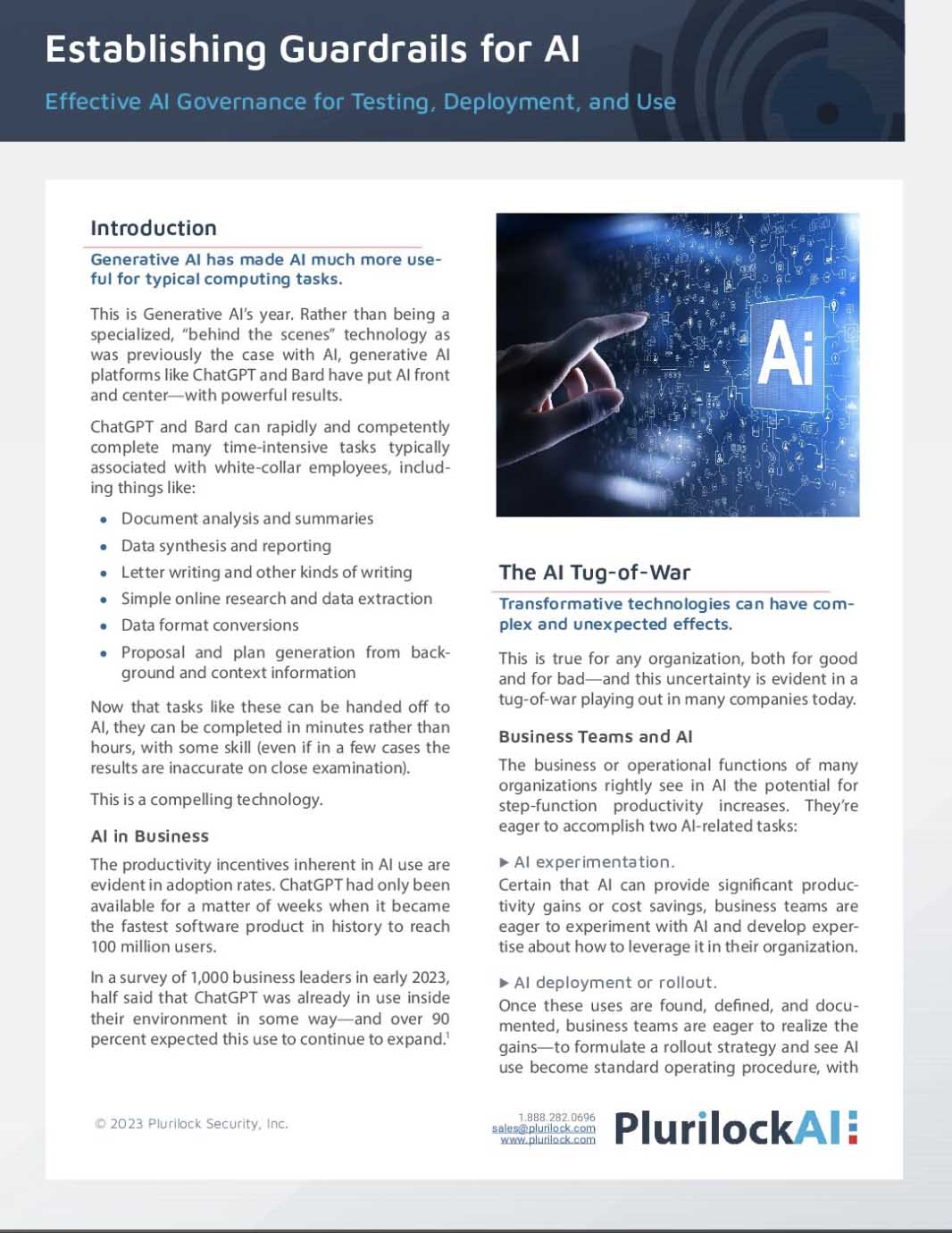
Establishing Guardrails for AI Whitepaper