Cybersecurity Reference > Glossary
What is Structured vs. Unstructured Data Risk?





Structured data lives in databases with clearly defined fields—customer records with specific columns for names, addresses, and account numbers, for instance. This predictability makes it easier to secure in some ways. You can encrypt specific fields, set granular access controls, and monitor queries for unusual patterns. But that same organization makes structured data an obvious target. Attackers know exactly where valuable information lives and can extract it efficiently once they breach perimeter defenses.
Unstructured data—emails, documents, images, videos, chat logs—is messier and more common, making up roughly 80% of enterprise data. It doesn't follow a predetermined schema, which creates real problems for security teams. Sensitive information might be buried anywhere: a social security number in an email attachment, proprietary algorithms in a PDF, confidential strategy notes in a presentation slide. Traditional security tools struggle with this variety. Data loss prevention systems might catch obvious patterns, but they often miss context-dependent risks. An employee might accidentally share a document containing trade secrets without triggering any alerts, simply because the content doesn't match known patterns. The lack of structure makes classification harder, policy enforcement inconsistent, and comprehensive monitoring nearly impossible without sophisticated content analysis capabilities.
Origin
Unstructured data proliferated with the rise of email, file sharing, and collaborative work tools in the 1990s and early 2000s. Organizations suddenly had vast repositories of documents, spreadsheets, and messages that didn't fit neatly into database schemas. The security implications weren't immediately obvious. Early data protection efforts focused on network perimeters and database security, assuming that controlling access to systems would be enough.
The shift came with high-profile data breaches in the 2000s and 2010s that exposed the vulnerability of unstructured data. Leaked email archives, stolen document repositories, and inadvertently shared files demonstrated that sensitive information was scattered across file systems, inboxes, and cloud storage platforms. Security professionals began recognizing that unstructured data required fundamentally different protection approaches—not just database controls applied to files, but content-aware systems that could understand and classify diverse information types regardless of format.
Why It Matters
Compliance frameworks increasingly recognize this reality. Regulations like GDPR and CCPA require organizations to track and protect personal information wherever it lives, not just in customer databases. A spreadsheet containing email addresses carries the same regulatory weight as a CRM system. But finding and protecting that spreadsheet is exponentially harder when it might exist in dozens of versions across email, file shares, and individual laptops.
The rise of generative AI has added another complication. Large language models train on unstructured data, potentially memorizing and reproducing sensitive information from documents, emails, and chat logs. Organizations need to understand what unstructured data they have, where it lives, and what risks it carries—not just for traditional security purposes, but to prevent inadvertent exposure through AI systems.
The Plurilock Advantage
We don't just apply generic policies—we work with your organization to understand where your most critical data lives, whether that's in legacy databases or scattered across cloud collaboration platforms.
Our data protection services combine technical controls with practical governance that accounts for the realities of how your teams create, share, and store information every day.
.
Need Help Managing Your Data Risks?
Plurilock's data classification services help identify and secure both structured and unstructured information assets.
Get Data Classification Help → Learn more →Downloadable References
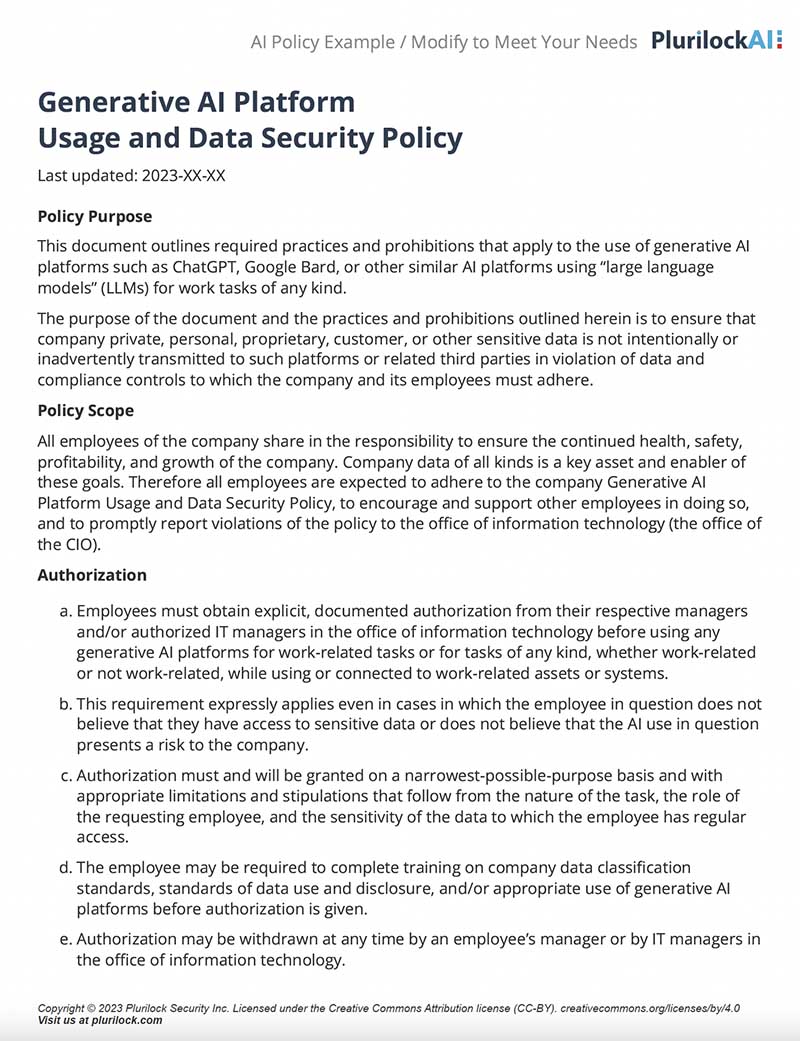
Sample Governance Policy for AI Use
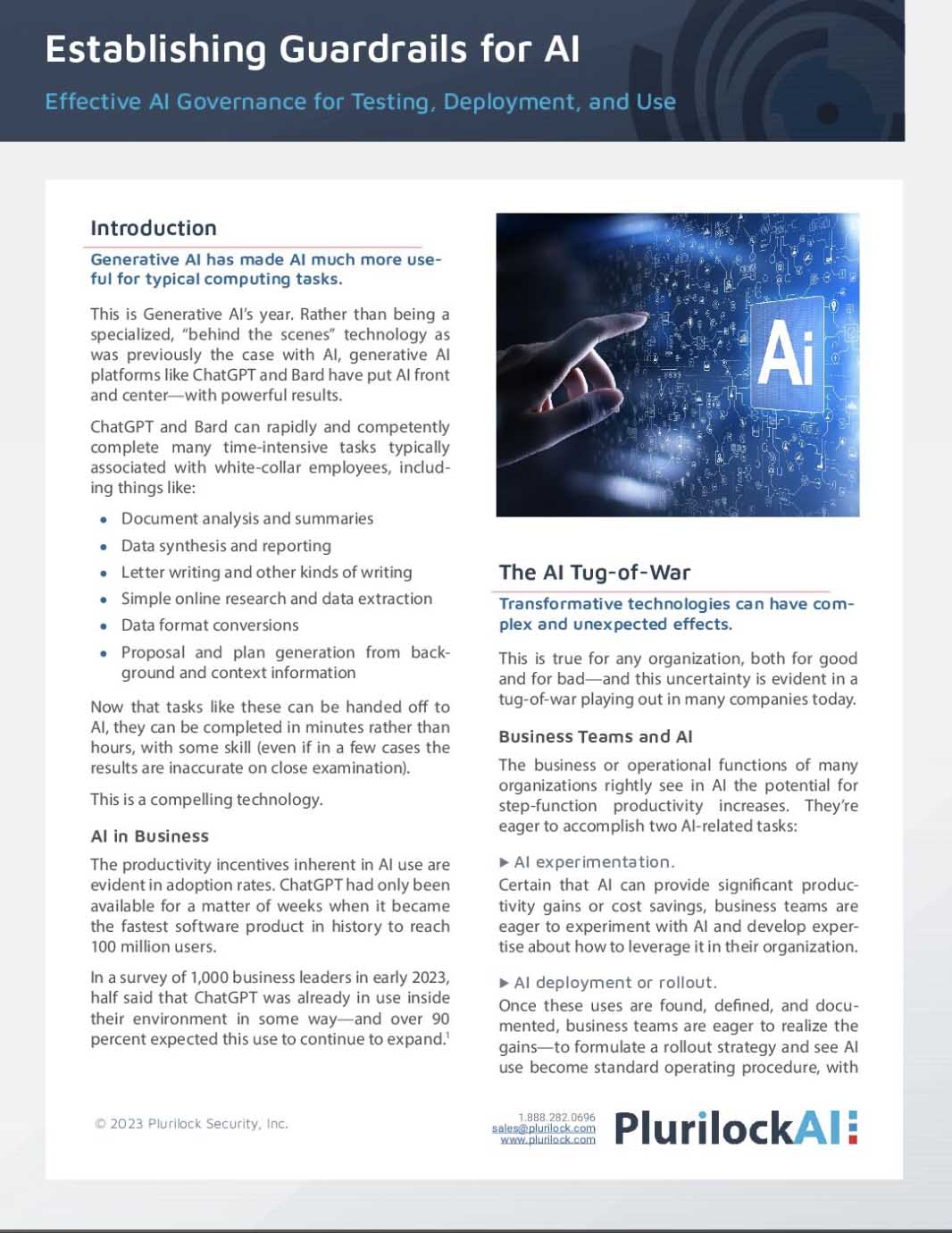
Establishing Guardrails for AI Whitepaper