Cybersecurity Reference > Glossary
What is an AI Attack Surface?





This includes both conventional vulnerabilities in the supporting infrastructure and novel attack vectors that specifically target how machine learning systems process information and make decisions. Unlike traditional software, AI systems introduce unique exposure points throughout their lifecycle—from data collection and model training through deployment and ongoing inference operations.
Attackers can target these systems in ways that exploit their statistical nature. Data poisoning corrupts training sets to skew model behavior. Adversarial examples use carefully crafted inputs to trigger misclassifications. Model inversion attacks extract sensitive training data. Prompt injection exploits how language models parse instructions. Each of these represents a fundamentally different security challenge than what organizations face with conventional applications.
The expanding attack surface matters because AI systems often operate in high-stakes environments—fraud detection, access control, content moderation, autonomous systems. A compromised model doesn't just fail; it can make wrong decisions that look legitimate, bypass security controls while appearing to function normally, or leak sensitive information embedded in its training data. Defending this surface requires understanding both traditional security principles and the unique vulnerabilities that emerge from statistical learning systems.
Origin
This changed around 2014 when researchers demonstrated adversarial examples—inputs deliberately modified to fool image classifiers while remaining imperceptible to humans. These attacks revealed that machine learning models had vulnerabilities distinct from software bugs or configuration errors. The models were working as designed, yet could be systematically manipulated through carefully constructed inputs.
As organizations deployed AI more widely—in facial recognition, autonomous vehicles, content filtering, and financial systems—researchers identified additional attack vectors. Data poisoning emerged as a concern when training on untrusted sources. Model extraction attacks showed that proprietary models could be reverse-engineered through their outputs. Membership inference revealed privacy leaks in trained models. By the late 2010s, the AI attack surface had become recognized as a distinct security domain requiring specialized defenses beyond conventional security measures.
Why It Matters
The challenge intensifies because AI vulnerabilities often leave no obvious traces. Traditional intrusions trigger alerts, generate logs, or cause visible failures. An adversarially manipulated model might operate indefinitely with its behavior subtly altered, making malicious decisions that appear legitimate. This invisibility makes detection difficult and delayed response likely.
Organizations face particular pressure as AI adoption accelerates faster than security understanding. Teams deploy large language models, computer vision systems, and automated decision engines without fully grasping their attack surfaces. Regulatory frameworks struggle to keep pace, leaving security responsibilities ambiguous. Meanwhile, adversaries actively research AI vulnerabilities, sharing techniques for prompt injection, jailbreaking, and model manipulation. The gap between deployment speed and security maturity creates substantial risk that conventional security tools aren't designed to address.
The Plurilock Advantage
We assess AI implementations for vulnerabilities that conventional security testing misses, from prompt injection risks to data poisoning exposure.
Our AI risk assessment services help organizations understand their actual exposure across the AI lifecycle and implement defenses that address both traditional and AI-specific attack vectors without disrupting operational effectiveness.
.
Worried About AI-Related Security Risks?
Plurilock's AI security assessment identifies vulnerabilities in your AI infrastructure.
Get AI Security Assessment → Learn more →Downloadable References
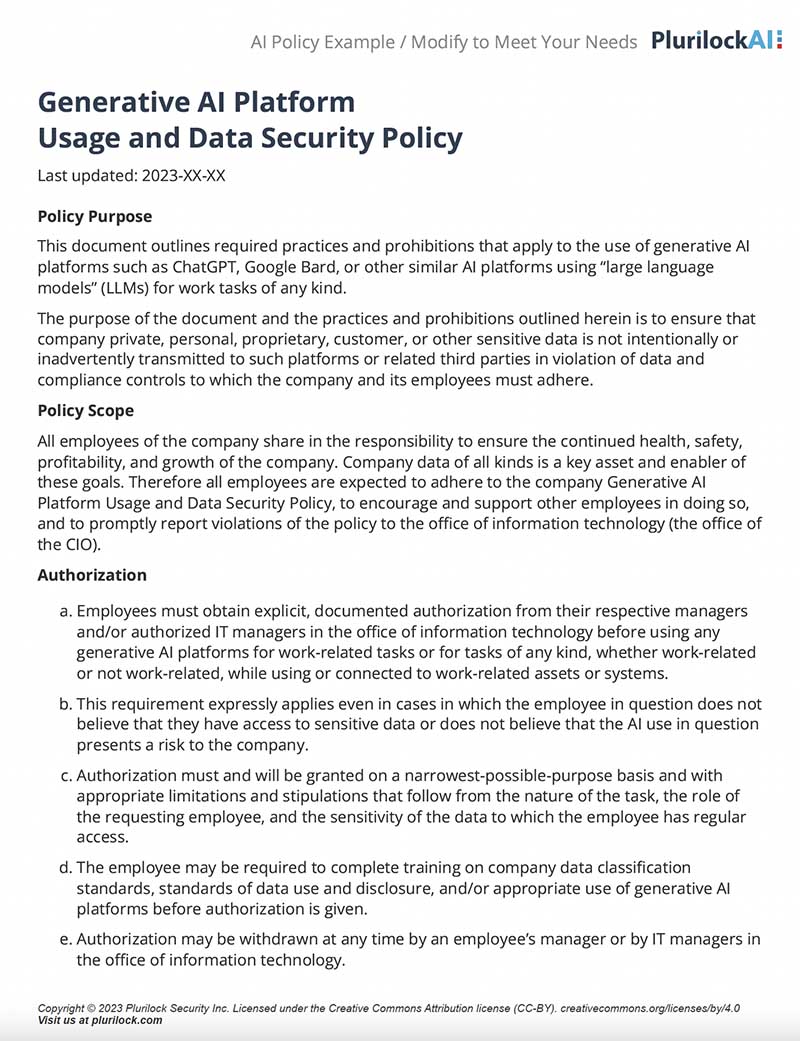
Sample Governance Policy for AI Use
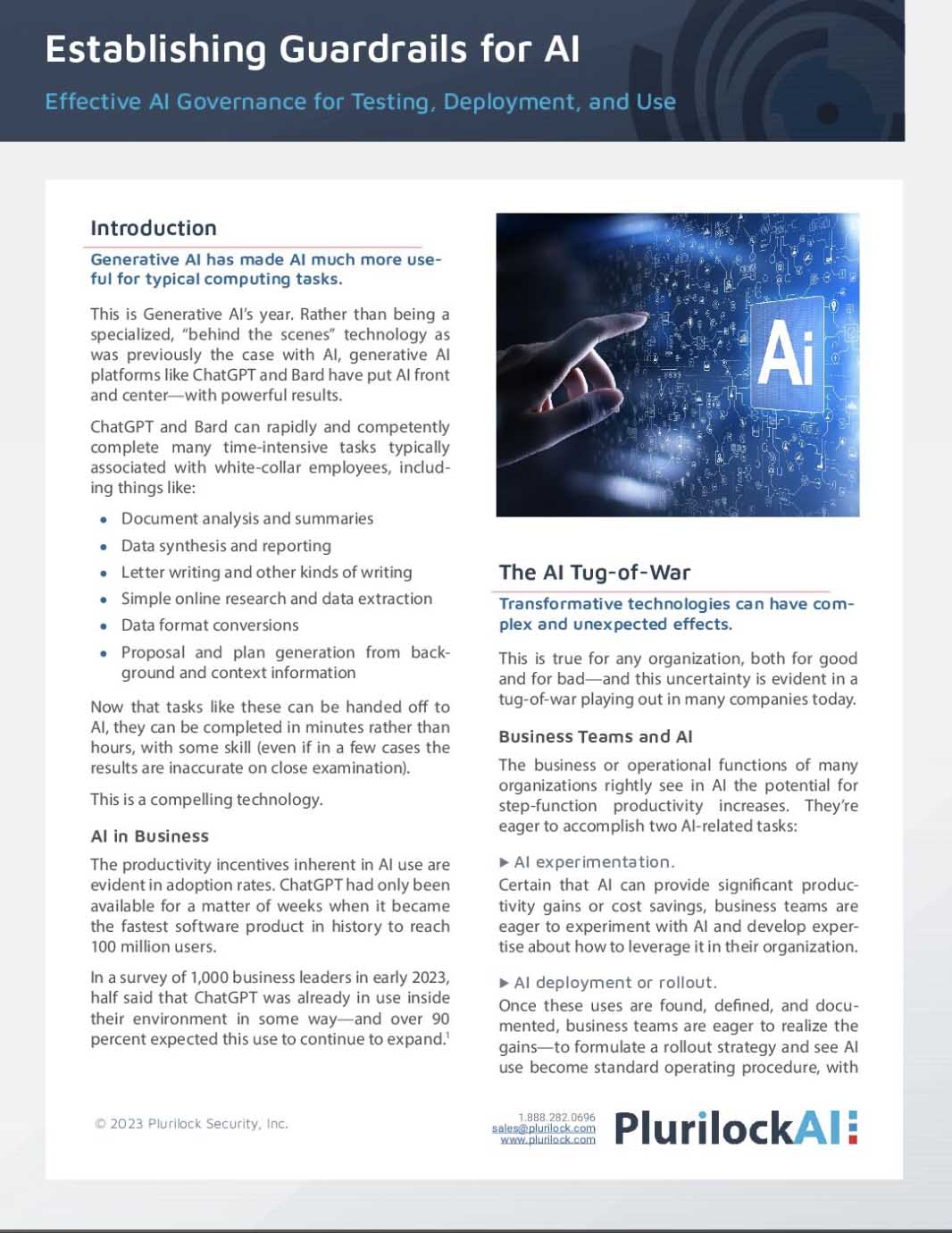
Establishing Guardrails for AI Whitepaper