Cybersecurity Reference > Glossary
What is Model Integrity?



The concern isn't abstract—attackers can corrupt training data to introduce subtle biases, tamper with model parameters to change behavior, or extract proprietary models to steal intellectual property. These attacks can happen at any point: during initial training, when the model gets deployed, or while it's running in production.
The threats take different forms depending on the stage. Training data poisoning plants malicious examples that skew what the model learns. Model extraction attacks use carefully crafted queries to reverse-engineer proprietary algorithms. Direct tampering alters the model files themselves to inject backdoors or modify decision-making logic. Even seemingly minor changes to model weights can shift outputs in ways that serve an attacker's goals.
Protecting model integrity requires treating models like any other critical system component. That means cryptographic signatures to verify model files haven't changed, access controls on model repositories, secure storage with audit logging, and continuous monitoring for unauthorized modifications. Chain of custody matters too—tracking who touched the model and when throughout development and deployment. The stakes are highest in domains like medical diagnosis, autonomous systems, or fraud detection, where a compromised model doesn't just produce bad results; it can endanger lives or enable financial theft.
Origin
The turning point came when academic papers showed how training data could be poisoned to create backdoors in models, and how models themselves could be stolen through prediction APIs. These weren't theoretical exercises. A 2019 study demonstrated extracting Google's proprietary translation model with surprising accuracy. Another showed how a single malicious training example could compromise a sentiment analysis model deployed at scale.
The problem intensified as models grew larger and more complex. Today's large language models and deep neural networks contain billions of parameters, making manual verification impossible. The supply chain got messier too—organizations started using pre-trained models from public repositories, fine-tuning models trained by third parties, and deploying models in distributed environments where traditional perimeter security doesn't apply. Model integrity became less about preventing one specific attack and more about establishing trust across an entire pipeline.
Why It Matters
The risk extends beyond individual decisions. Models trained on poisoned data can embed biases or backdoors that persist through their entire operational life, triggering only when specific conditions occur. An attacker might plant a trigger that activates months after deployment, making the connection between compromise and effect nearly impossible to trace. This delayed activation makes model integrity harder to verify than traditional software, where behavior tends to be more deterministic.
The stakes keep rising as organizations deploy AI in more critical systems and as models become more opaque. A compromised large language model used for customer service could leak sensitive information or spread misinformation at scale. Financial trading algorithms with tampered models could manipulate markets. The move toward federated learning and edge deployment creates new attack surfaces where models process sensitive data in environments with weaker security controls. Unlike a software bug that affects all users equally, a compromised model might behave normally for most inputs while failing catastrophically on specific, attacker-chosen scenarios.
The Plurilock Advantage
Our AI risk assessment services evaluate model integrity throughout the lifecycle—from training data validation to deployment verification to runtime monitoring. We work with organizations to establish chain of custody controls, implement cryptographic signing for model files, and build verification processes that catch tampering before it reaches production.
.
Need to Verify Your AI Model Integrity?
Plurilock's advanced testing can validate your models against tampering and corruption.
Validate Model Security → Learn more →Downloadable References
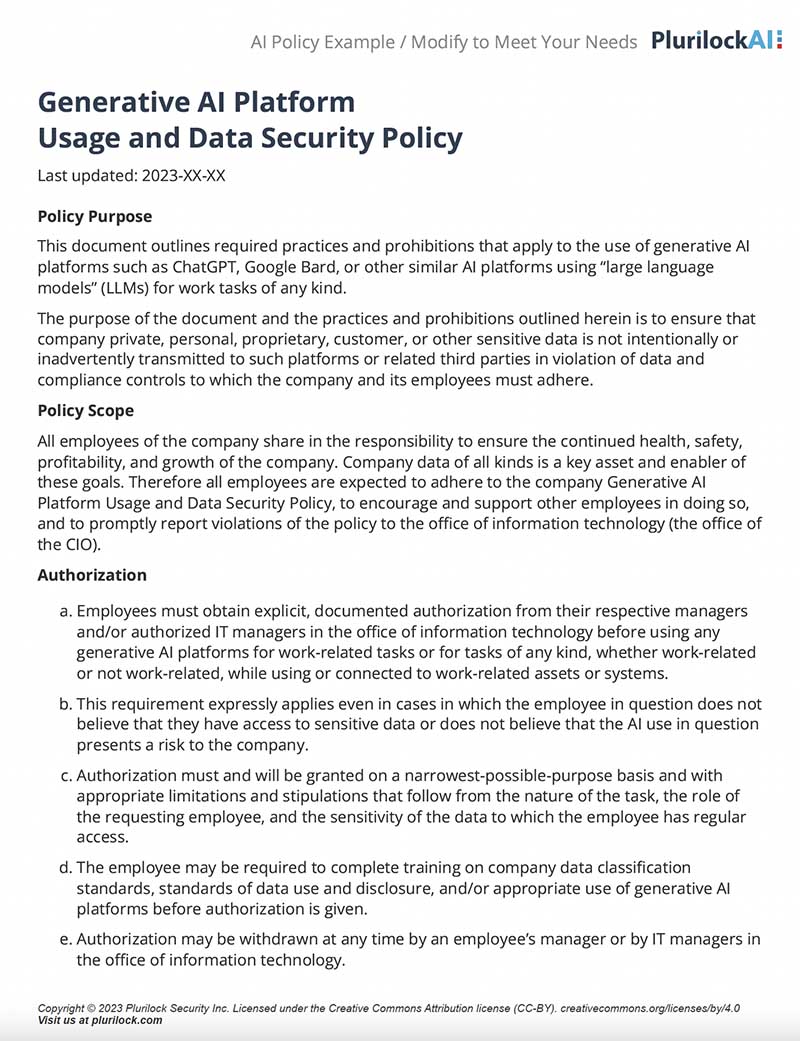
Sample Governance Policy for AI Use
Establishing Guardrails for AI Whitepaper