Cybersecurity Reference > Glossary
What is Residual Risk?





No security program eliminates every threat—some level of exposure always remains, whether from zero-day vulnerabilities, sophisticated attackers with unlimited resources, or simple bad luck. The question isn't whether residual risk exists, but whether you understand it and can live with it.
You calculate residual risk by looking at your inherent risk—what you'd face with no protections at all—and subtracting what your controls actually mitigate. If your payment system starts with a high likelihood of breach but your encryption, network segmentation, and monitoring reduce that exposure by seventy percent, the remaining thirty percent is your residual risk. That calculation sounds precise, but it rarely is. Risk quantification involves estimates, assumptions, and educated guesses about both threat likelihood and control effectiveness.
The real work comes in deciding what residual risk you can accept. Different organizations tolerate different levels based on their risk appetite, regulatory requirements, and business models. A financial institution might accept minimal residual risk around customer data, while a marketing firm might tolerate more. When residual risk exceeds your threshold, you have choices: implement additional controls, transfer the risk through insurance, or accept the potential consequences. Good risk management means making that decision deliberately rather than discovering your tolerance only after something breaks.
Origin
Cybersecurity borrowed this framework in the 1980s and 1990s as organizations began treating information security as a business problem rather than purely a technical one. Early risk assessments for mainframe systems applied residual risk concepts to questions about access controls and backup procedures. The approach was often informal—security teams knew they couldn't stop every threat, but formal residual risk calculations were rare outside of government and defense contexts.
The concept gained prominence in the 2000s as compliance frameworks like ISO 27001 and NIST required explicit risk treatment decisions. These standards pushed organizations to document not just their controls but also the risks that remained afterward. The shift toward risk-based compliance made residual risk analysis essential rather than optional. More recently, cyber insurance has forced better residual risk articulation—insurers want quantified estimates of remaining exposure before they'll price a policy. This has driven improvements in how organizations measure and communicate about the risks their security programs don't fully address.
Why It Matters
Compliance frameworks now expect explicit residual risk statements. Auditors want to see that you've identified what remains unmitigated and that leadership has consciously accepted that exposure. This isn't just paperwork—it forces conversations about whether current security spending is sufficient and where resources should go next. Board members increasingly ask about residual risk in quantified terms, wanting dollar figures for potential losses rather than abstract risk ratings.
The rise of cyber insurance has added another dimension. Insurers evaluate your residual risk to price policies and determine coverage limits, which means your risk calculations directly affect your insurance costs and available protection. Organizations that can't articulate their residual risk clearly often struggle to get affordable coverage or find that their policies exclude the exact scenarios they most need covered. Meanwhile, the shift toward continuous compliance and zero-trust architectures means residual risk isn't a one-time calculation but an ongoing measurement that changes as your environment and threats evolve.
The Plurilock Advantage
Our governance, risk, and compliance services include continuous residual risk monitoring that adapts as your environment and threat landscape change.
With expertise from former intelligence professionals and Fortune 500 CISOs, we bring the depth needed to identify residual risks that less experienced assessors miss, helping you make informed choices about the exposures you're actually carrying.
.
Need Help Managing Your Residual Risk?
Plurilock's risk assessment services help identify and mitigate remaining security exposures.
Get Risk Assessment → Learn more →Downloadable References
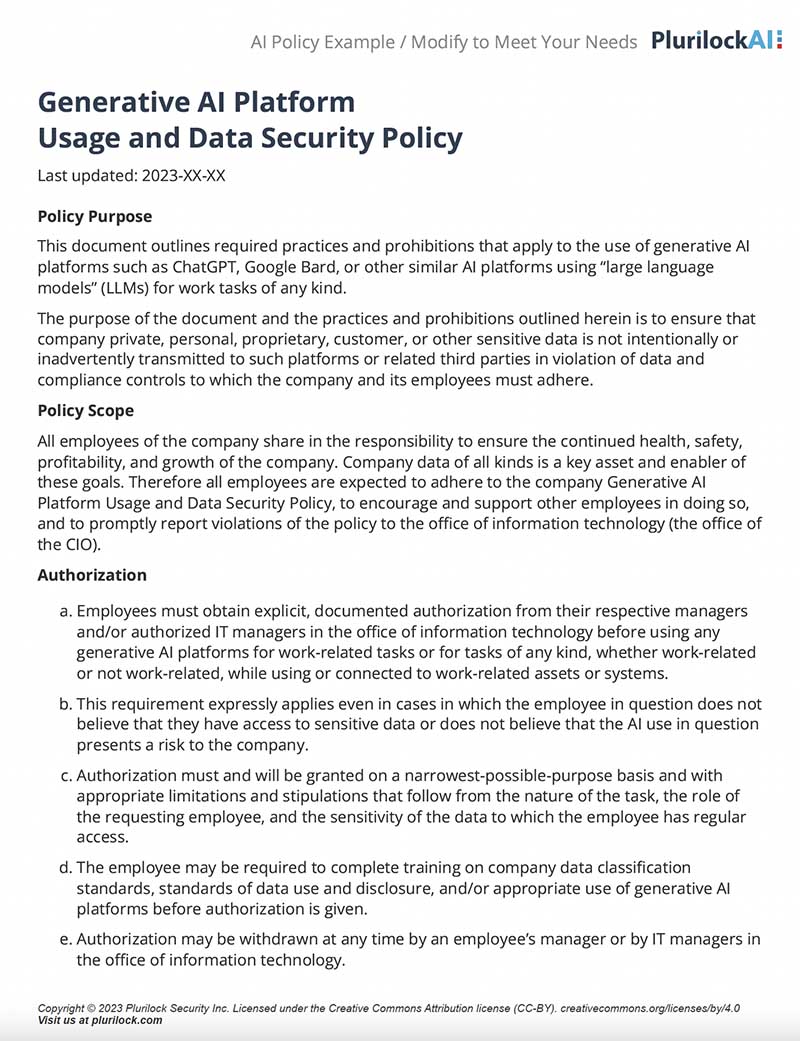
Sample Governance Policy for AI Use

Establishing Guardrails for AI Whitepaper