Cybersecurity Reference > Glossary
What is False Acceptance Rate (FAR)?





When you scan your fingerprint or face to unlock a device, there's always some probability the system will incorrectly match you with someone else in its database—or accept an imposter as you. FAR expresses this as a percentage or ratio: a FAR of 0.01% means the system falsely accepts someone roughly one time in every 10,000 authentication attempts.
This metric exists in tension with its counterpart, False Rejection Rate, which measures how often legitimate users get denied. Tightening security to reduce false acceptances typically increases false rejections, frustrating authorized users who can't get in. System designers constantly balance these trade-offs based on what's at stake. A consumer phone might tolerate a slightly higher FAR for convenience, while a system protecting classified data or financial transfers needs FAR pushed as close to zero as technically feasible. In high-security contexts, even a 0.001% false acceptance rate can represent an unacceptable risk when millions of authentication attempts occur daily.
Origin
By the 1980s, as biometric research matured into commercial products, the field standardized around FAR and FRR as fundamental performance metrics. Manufacturers needed objective ways to compare competing technologies, and security professionals needed meaningful specifications when evaluating systems. The international biometric standards community, including organizations like NIST and ISO, formalized these definitions and testing methodologies.
As biometric authentication expanded from niche government and forensic applications into consumer devices during the 2000s and 2010s, FAR took on new significance. Millions of people now rely on biometric systems daily, making the practical implications of these error rates much more visible. Modern systems can achieve remarkably low false acceptance rates—sometimes below 0.0001%—through advances in sensors, machine learning, and multi-modal fusion that combines multiple biometric factors.
Why It Matters
The real-world implications get more complex when you consider scale. A seemingly impressive 99.99% accuracy sounds good until you realize a large organization processing millions of authentication events daily will experience hundreds or thousands of false acceptances. Attack surface expands accordingly. And unlike passwords, you can't simply reset a compromised biometric—your fingerprints and face are permanent.
Modern threats compound these concerns. Presentation attacks using high-resolution photos, 3D-printed fingerprints, or deepfake video can artificially inflate false acceptance rates beyond their natural baseline. Meanwhile, organizations increasingly rely on biometric authentication for remote access, where verifying liveness and defeating spoofing attempts becomes harder. Regulatory frameworks around data protection and authentication now often specify acceptable FAR thresholds for different risk levels, making this once-technical metric a compliance issue.
The Plurilock Advantage
Our practitioners assess existing biometric controls, test them against real-world attack scenarios, and design layered authentication architectures that don't rely solely on any single factor.
When biometric systems form part of your security posture, we ensure they're configured, monitored, and integrated properly—not just deployed and forgotten. Learn more about our identity and access management services.
.
Downloadable References

Sample Governance Policy for AI Use
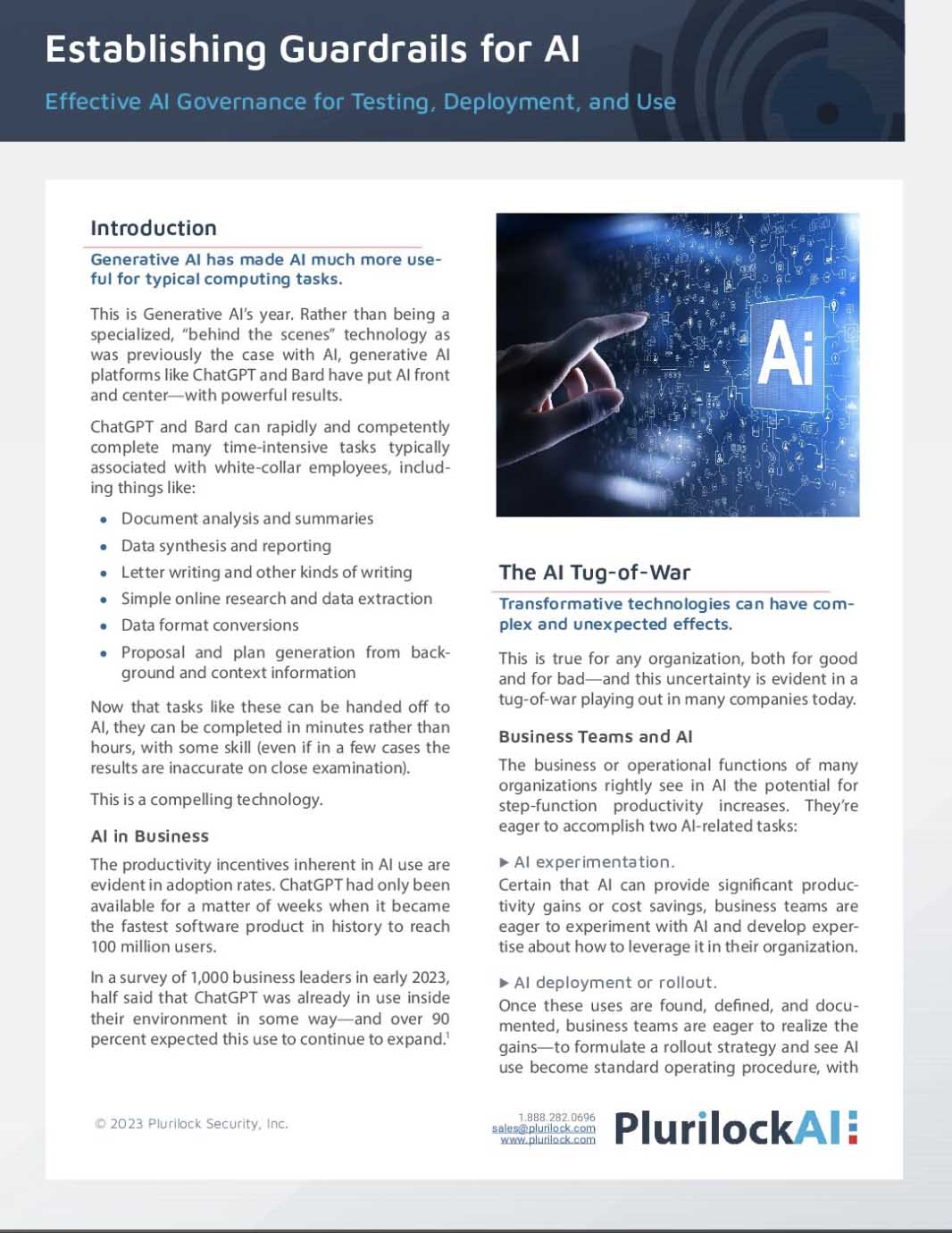
Establishing Guardrails for AI Whitepaper