Cybersecurity Reference > Glossary
What is an Incident Severity Rating?

Think of it as triage for cyberattacks—when alerts are flooding in, organizations need a clear way to separate the critical from the routine. Most systems use a tiered approach, often running from Level 1 (Critical) down to Level 4 or 5 (Low), though the exact scale varies by organization.
The rating takes into account several factors: how much business impact the incident could cause, what kind of data is at risk, which systems are involved, and whether the situation might get worse. A ransomware attack encrypting production databases would rank as critical. Unauthorized access to customer records would be high severity. A single workstation with malware might be medium. A false positive from an overly sensitive detection rule would land at low.
Many organizations tie response times to each level. Critical incidents might demand a response within fifteen minutes, while low-severity events could wait a day or two. This structure prevents security teams from burning out on minor issues while missing the threats that actually matter. When everyone knows what "critical" means—and what it doesn't—the response becomes faster and more focused.
Origin
The shift gained momentum after high-profile breaches demonstrated that not all security events deserved equal attention. Organizations realized they were spending equivalent time investigating harmless anomalies and genuine intrusions. Frameworks like ITIL (Information Technology Infrastructure Library) formalized incident management processes, including severity classification, which security teams then customized for their needs.
The rise of Security Operations Centers in the 2000s made standardized severity ratings essential. When multiple analysts work shifts across different time zones, everyone needs a shared understanding of what constitutes an emergency. Federal standards like NIST and FIPS guidelines reinforced this by recommending formal incident categorization. More recently, automated systems and SOAR platforms have made severity rating even more crucial, since machines need clear criteria to escalate appropriately without human judgment at every step.
Why It Matters
Severity ratings also shape how organizations allocate their limited security resources. A small team can't maintain 15-minute response times for every alert, but they can maintain it for genuine emergencies if those are clearly identified. The rating system becomes a forcing function for honest conversations about risk tolerance and operational capacity.
The challenge today is that severity ratings can create false confidence. An incident marked "low" might actually be reconnaissance for a more sophisticated attack, or a critical breach might be misclassified because automated systems lack context. Attackers increasingly understand how defenders prioritize incidents, and some deliberately trigger low-severity alerts to mask their real activities. The rating is only as good as the criteria behind it and the judgment of the people—or algorithms—applying those criteria. Organizations that treat severity ratings as fixed truth rather than informed estimates often miss threats hiding in the noise.
The Plurilock Advantage
We help organizations design rating systems that reflect their actual risk profile and operational capacity, then integrate those systems into their security tools and workflows.
When incidents occur, our SOC operations and support services provide the rapid response that critical events demand, with the experience to question severity ratings when something doesn't add up. We mobilize in days, not weeks, because real incidents don't wait for lengthy onboarding processes.
.
Need Help Establishing Incident Severity Standards?
Plurilock's incident response experts can help you develop comprehensive severity rating frameworks.
Get Severity Framework Guidance → Learn more →Downloadable References

Sample Governance Policy for AI Use
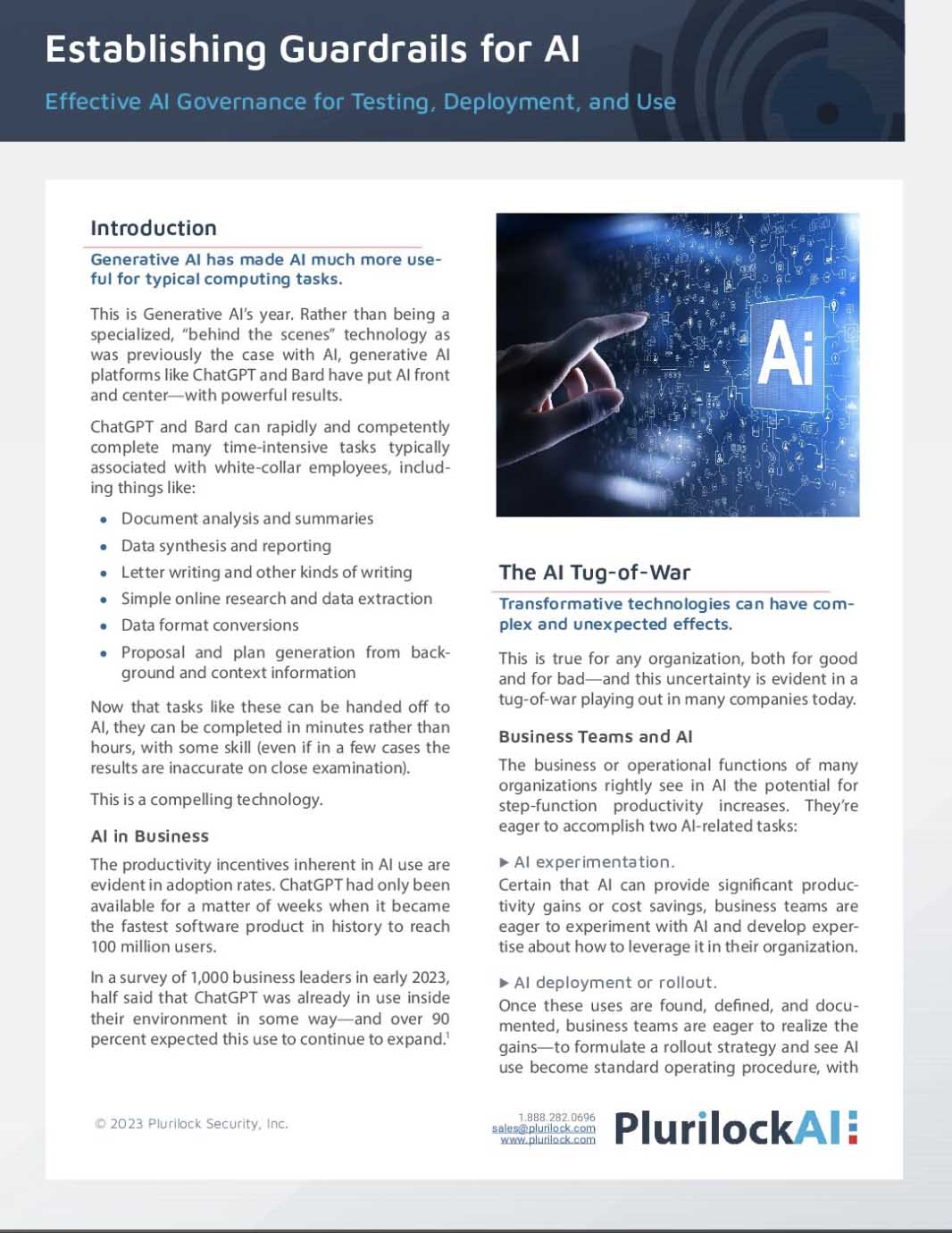
Establishing Guardrails for AI Whitepaper