Cybersecurity Reference > Glossary
What is Identity Context?



It's the digital equivalent of recognizing someone by their walk, their handwriting, and their habits, not just their face.
Traditional authentication asks "do you know the password?" Identity context asks "are you really behaving like the person who owns this account?" The difference matters because attackers can steal credentials, but they can't easily replicate the subtle patterns of how someone naturally interacts with their systems. A user's typing rhythm, mouse movements, typical login times, preferred applications, and usual network locations create a behavioral signature that's harder to fake than a password.
This approach enables continuous authentication rather than a single checkpoint at login. If someone's credentials get compromised and an attacker logs in from across the world at 3 AM using unfamiliar keystrokes, identity context systems can detect that something's off. The same logic applies to insider threats—if a legitimate user suddenly starts accessing files they've never touched before or exhibits unusual navigation patterns, those deviations stand out against their established behavioral baseline.
Identity context represents a shift from static "keys to the kingdom" toward dynamic, probabilistic security that adapts to how people actually work.
Origin
Initially, behavioral biometrics were considered supplementary to traditional methods. The thinking was narrow: could we use typing patterns as another factor in multi-factor authentication? But as machine learning capabilities expanded in the 2010s, researchers realized they could combine dozens of behavioral and environmental signals into a richer model of user identity.
The rise of cloud computing and mobile devices accelerated this shift. When users access systems from anywhere on multiple devices, traditional perimeter security breaks down. Organizations needed ways to verify not just that someone had valid credentials, but that the person using those credentials was genuinely the authorized user.
The term "identity context" gained traction as vendors and security frameworks moved beyond simple behavioral biometrics to incorporate environmental factors—IP addresses, geolocation, device fingerprinting, time-based patterns, and application usage. What started as keystroke analysis evolved into a comprehensive approach to understanding digital identity.
Why It Matters
The shift to remote work has made traditional network-based security models obsolete. When employees access corporate resources from home networks, coffee shops, and travel locations, organizations need ways to distinguish legitimate remote access from compromised accounts. Identity context provides that distinction by evaluating whether access patterns match established user behavior.
Insider threats pose a different challenge. A malicious employee already has legitimate credentials and authorized access, but their actions—accessing unusual files, downloading large datasets, or working at odd hours—may deviate from their normal patterns. Identity context helps detect these anomalies before significant damage occurs.
Zero trust architectures depend on continuous verification rather than implicit trust based on network location. Identity context provides the behavioral and environmental intelligence that makes continuous verification practical, moving security from a binary authenticated/not-authenticated state to a more nuanced risk-based model.
The Plurilock Advantage
Our identity and access management services leverage decades of experience in behavioral analysis and zero trust architectures to implement identity context solutions that adapt to your environment.
We don't just deploy tools—our team of former intelligence professionals and enterprise security leaders designs systems that balance security with usability, ensuring that legitimate users aren't hampered while threats are quickly identified.
We mobilize quickly, often in days rather than months, to strengthen your authentication posture with identity context intelligence.
.
Ready to Enhance Your Identity Context?
Plurilock's advanced identity verification solutions provide seamless, continuous user authentication.
Get Identity Solutions Now → Learn more →Downloadable References
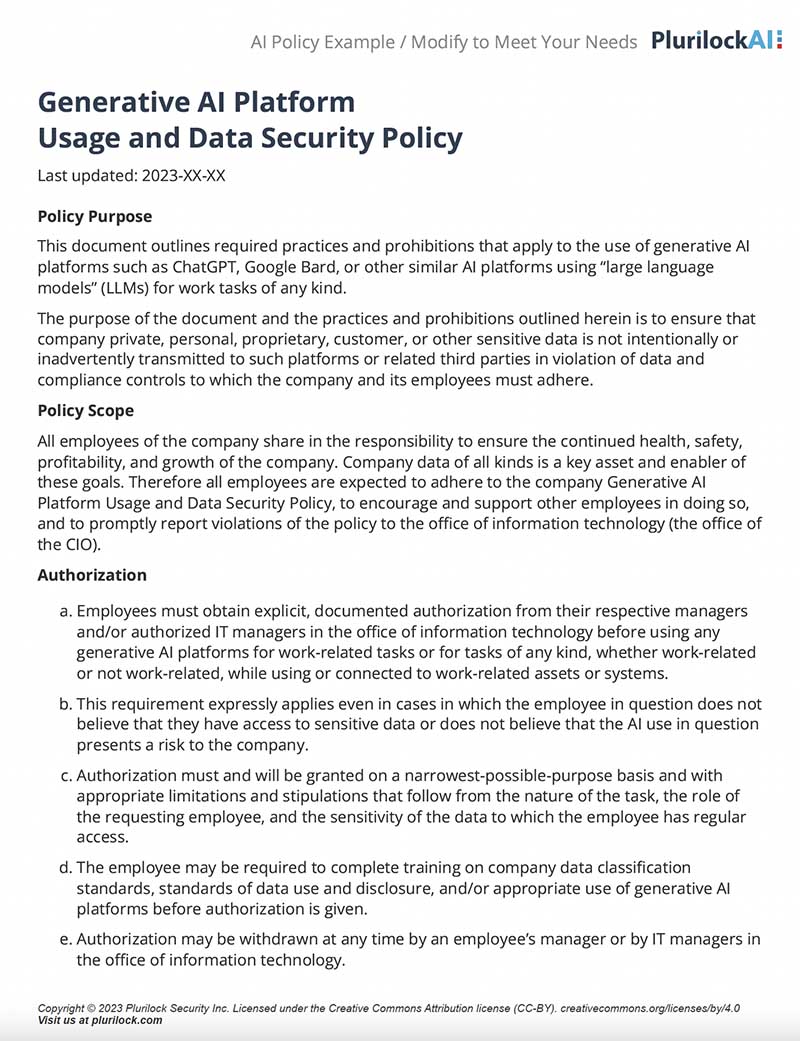
Sample Governance Policy for AI Use
Establishing Guardrails for AI Whitepaper