Cybersecurity Reference > Glossary
What is Inference Abuse?





Rather than directly accessing protected data, attackers make educated guesses based on observable behaviors, metadata, or indirect signals from systems, applications, or users. The technique exploits the gap between what data is explicitly protected and what can be deduced from available information.
An attacker might analyze timing patterns in database queries to infer the presence of specific records, or examine network traffic patterns to deduce user activities without accessing the actual content. In machine learning contexts, inference attacks can reveal training data or model parameters through carefully crafted queries. The attacks are particularly dangerous because they circumvent traditional access controls while appearing to operate within normal system parameters.
Common forms include membership inference attacks against machine learning models, timing-based side-channel attacks, and statistical disclosure attacks against anonymized datasets. Defenses require differential privacy techniques, query result perturbation, rate limiting, and careful system design that minimizes information leakage through indirect channels. Organizations must consider not just what data they protect directly, but what information adversaries might infer from seemingly innocuous system behaviors.
Origin
As computing evolved, so did inference techniques. The rise of data mining in the 1990s highlighted how correlation and pattern analysis could extract hidden relationships from large datasets. Researchers demonstrated that anonymized data could often be re-identified by cross-referencing with other publicly available information, undermining privacy guarantees that seemed robust on paper.
The machine learning boom of the 2010s introduced new inference risks. Researchers showed that trained models could leak information about their training data through membership inference attacks. The problem intensified with large language models and generative AI, where models might inadvertently memorize and reproduce sensitive training data. What started as a database security concern has become a fundamental challenge across all data-driven systems, requiring constant vigilance as new technologies create new inference opportunities.
Why It Matters
Machine learning systems have become particularly vulnerable. Models trained on sensitive data can reveal whether specific individuals were in the training set, or even reproduce portions of that data. As organizations deploy AI for everything from customer service to medical diagnosis, the inference risk grows. Regulatory frameworks like GDPR and CCPA emphasize privacy protection, but many organizations focus on direct data access while overlooking what adversaries can infer from system behaviors.
The challenge extends beyond external attackers. Insiders with legitimate access to logs, analytics, or system metrics can piece together sensitive information they shouldn't know. As data becomes more distributed and processing moves to edge devices and cloud services, the attack surface for inference abuse expands continuously.
The Plurilock Advantage
Our team designs privacy-preserving architectures that minimize information leakage through side channels while maintaining operational functionality. We implement differential privacy techniques, design query controls, and establish monitoring to detect inference attempts. When others focus solely on access control, we consider the full spectrum of information disclosure risks.
.
Need Protection Against AI Inference Attacks?
Plurilock's advanced behavioral analytics can detect and prevent sophisticated inference-based threats.
Get Inference Protection Now → Learn more →Downloadable References
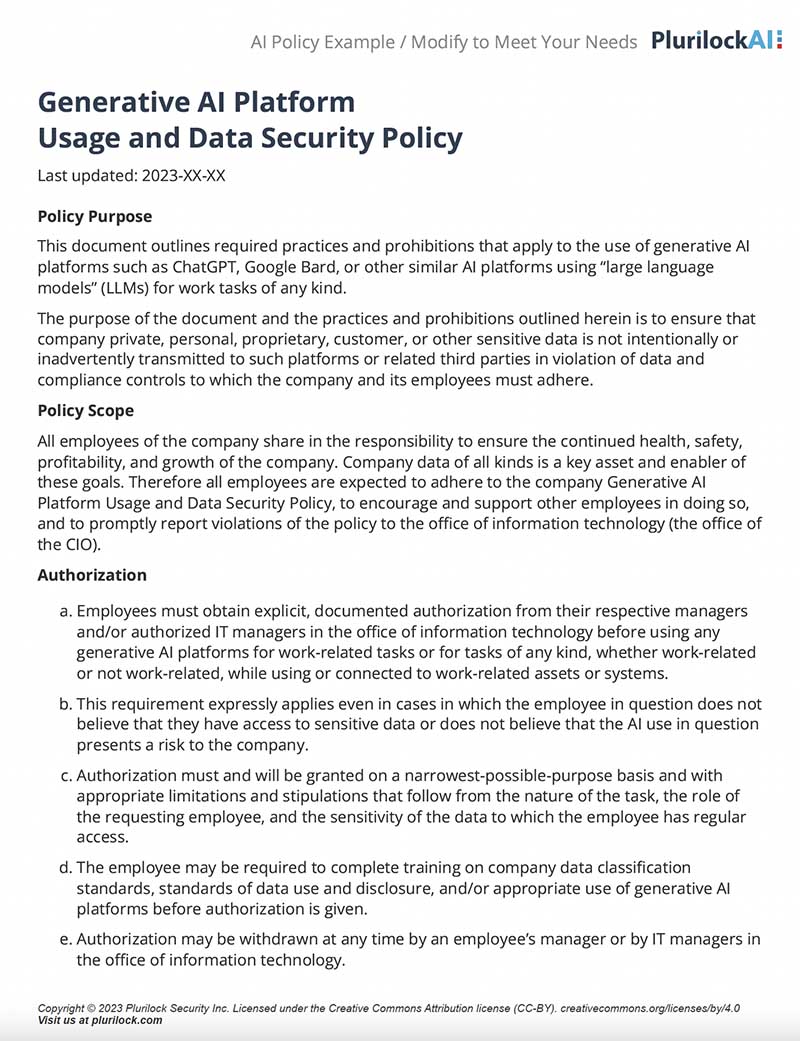
Sample Governance Policy for AI Use
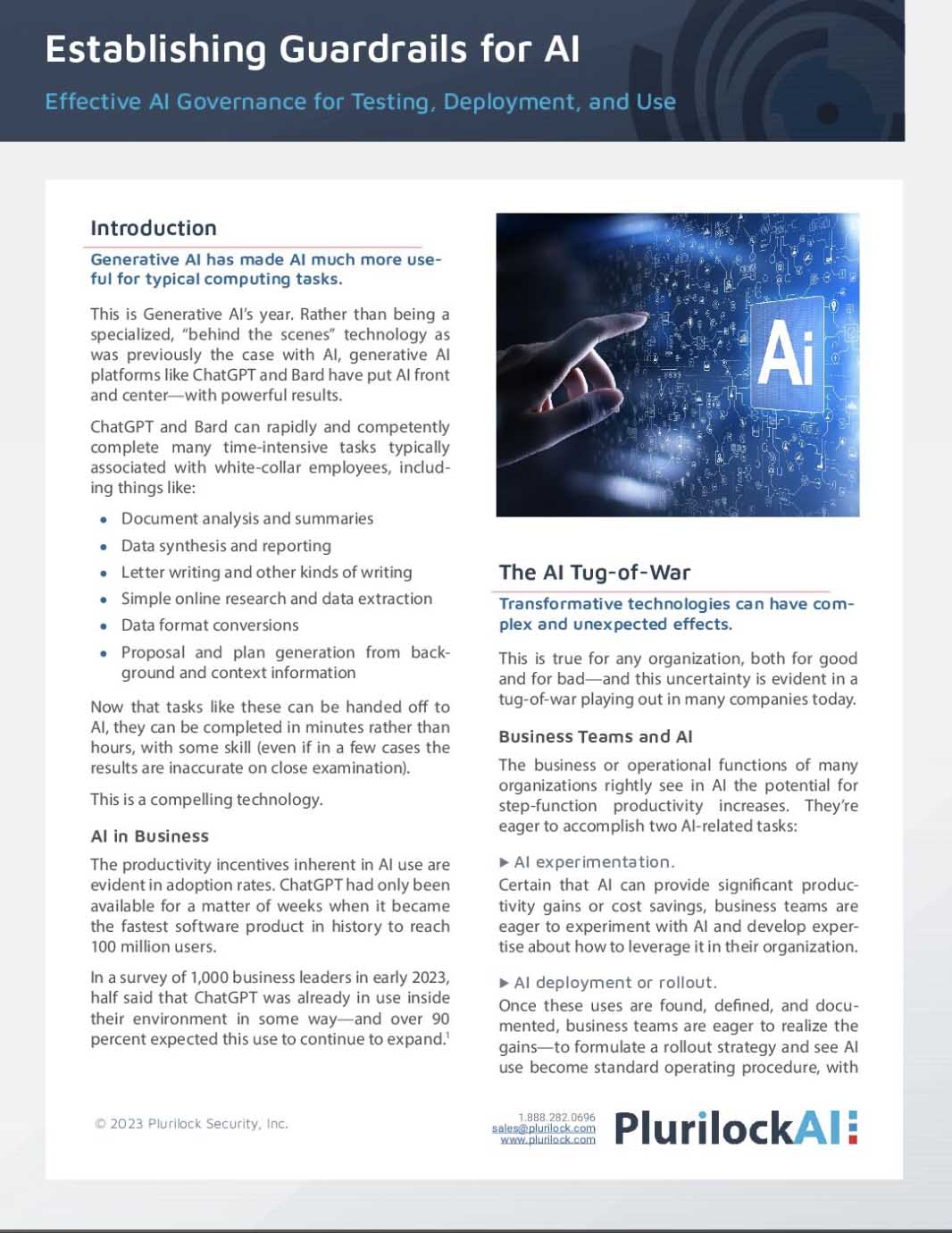
Establishing Guardrails for AI Whitepaper