
Cybersecurity Reference > Glossary
What is Invisible Authentication?



Instead of entering a code from their phone or pressing their thumb to a scanner, users simply log in with their username and password while the system quietly gathers additional verification signals in the background. These signals might include how they type, the device they're using, their location, or other behavioral and environmental factors. The authentication happens, but the user doesn't experience it as a separate step.
This approach solves a persistent problem with traditional multi-factor authentication: friction. Security teams know that MFA significantly reduces account compromise, but users find it tedious. Every extra step in the login process creates resistance, and in some environments—particularly those requiring frequent authentication—conventional MFA becomes genuinely disruptive. Invisible authentication delivers the security benefits of multiple verification factors while preserving the user experience of a simple password login. The system is still checking multiple things to confirm identity, but it does so without interrupting workflow or requiring additional user input beyond what they were already providing.
Origin
However, implementation revealed a significant problem: users hated it. Help desk tickets increased. Productivity decreased. In some cases, employees found workarounds that actually reduced security. The promise of MFA was clear, but the cost in user friction was real.
Behavioral biometrics research, which had been developing since the 1990s, offered a potential solution. Researchers discovered that typing patterns, mouse movements, and other behavioral signals could serve as identifying characteristics. Meanwhile, advances in machine learning made it practical to analyze these subtle patterns in real time. The combination created an opportunity: what if the system could verify identity by observing normal user behavior rather than demanding additional actions? Early implementations focused on keystroke dynamics, but the concept expanded to include device characteristics, network context, and other passive signals that could be collected without user involvement.
Why It Matters
More subtly, the friction of traditional MFA creates organizational resistance to security improvements. When every security enhancement makes the system harder to use, security teams face pushback on necessary measures. Invisible approaches remove this dynamic, making it easier to implement strong authentication without political battles over usability.
The shift toward zero-trust architectures makes this especially relevant. Zero-trust principles require continuous verification rather than one-time authentication at login. That's a hard sell if verification means repeatedly interrupting users to enter codes or scan fingerprints. Invisible authentication makes continuous verification practical by eliminating the interruption. The system can re-verify identity throughout a session without the user noticing, which is exactly what zero-trust models need.
The Plurilock Advantage
We've implemented invisible authentication solutions for organizations where traditional MFA created unacceptable friction, delivering measurably stronger security alongside improved user satisfaction.
Learn more about our identity and access management services.
.
Downloadable References
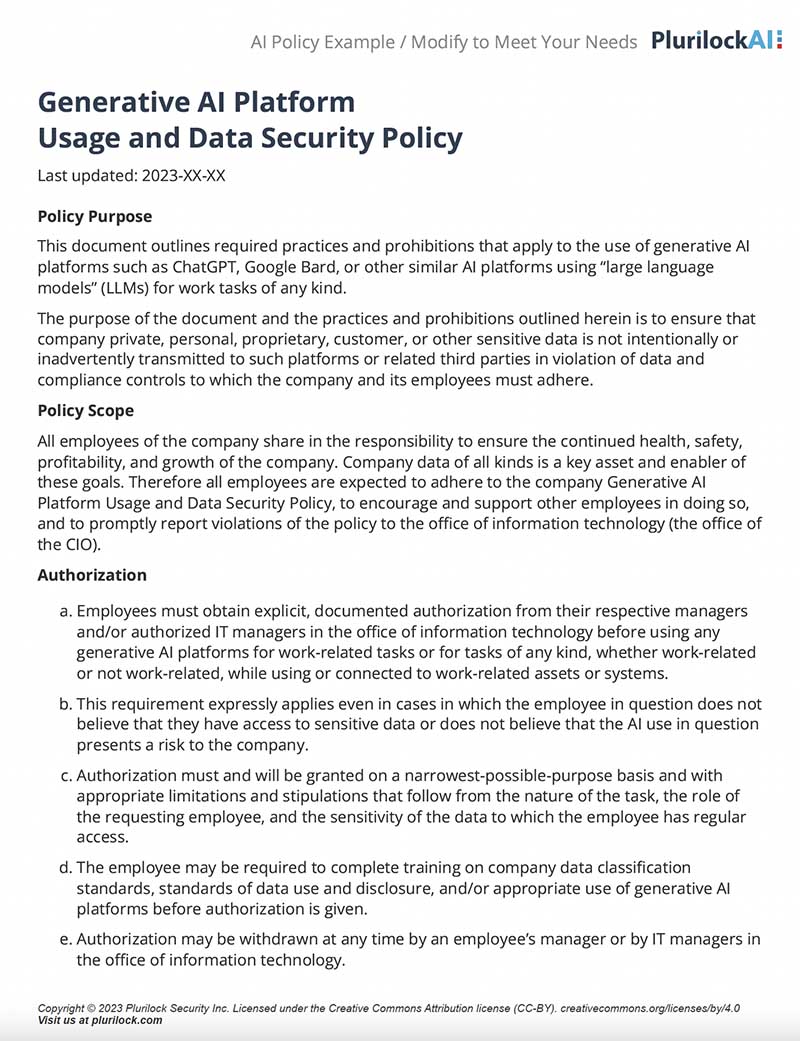
Sample Governance Policy for AI Use
Establishing Guardrails for AI Whitepaper