Cybersecurity Reference > Glossary
What is Attribute-Based Access Control (ABAC)?





Unlike traditional role-based systems that rely primarily on user roles, ABAC evaluates multiple dynamic attributes to make fine-grained access decisions in real-time.
ABAC systems consider user attributes (such as department, clearance level, or location), resource attributes (like classification level, owner, or creation date), and environmental attributes (including time of day, network location, or current threat level). These attributes are processed through policy rules that determine whether access should be granted.
This approach offers significant advantages over simpler access control models. It enables organizations to create highly specific policies that adapt to changing circumstances without requiring manual intervention. For example, a policy might allow financial data access only to accounting staff during business hours from corporate networks.
ABAC is particularly valuable in complex environments with diverse users, varied resources, and dynamic security requirements. Cloud computing, healthcare systems, and government agencies frequently implement ABAC to balance security with operational flexibility. However, the model's complexity can make policy management challenging, requiring careful design to avoid conflicts or unintended access permissions.
Origin
The National Institute of Standards and Technology began formalizing ABAC around 2010, publishing guidance that helped standardize terminology and implementation approaches. This work drew on earlier concepts like policy-based networking and trust management systems that had developed in parallel during the 2000s.
ABAC gained practical traction as organizations faced increasingly complex access requirements that role-based models couldn't efficiently handle. A hospital might have thousands of role combinations if they tried to capture every possible variation of who should access what patient data under which circumstances. ABAC offered a way to express these nuances without creating an unmanageable explosion of roles.
The rise of cloud computing accelerated ABAC adoption significantly. Cloud environments meant users, resources, and context shifted constantly in ways that made static role assignments impractical. Modern ABAC implementations often integrate with identity management platforms and can evaluate dozens of attributes in milliseconds when making access decisions.
Why It Matters
ABAC addresses this by letting security teams encode complex business logic directly into access policies. A contractor might access development systems during their contract period from approved locations, but lose that access immediately when the contract ends or if they connect from an unexpected country. These conditional rules happen automatically without manual intervention.
The model proves especially important for zero trust architectures, which assume no implicit trust and continuously verify access decisions. ABAC provides the granular, context-aware controls that zero trust requires. It can factor in device health, network location, data sensitivity, and current threat intelligence when deciding whether to grant access.
That said, ABAC's flexibility creates its own challenges. Policies can become intricate webs that are difficult to audit or troubleshoot. Conflicting rules might create security gaps or block legitimate access. Organizations implementing ABAC need strong governance processes and often benefit from tools that can simulate policy outcomes before deployment. When done right, though, ABAC delivers security that adapts to how people actually work.
The Plurilock Advantage
We help organizations assess their current access control gaps, design attribute frameworks that match their actual risk profile, and implement solutions that integrate with existing identity infrastructure. Our approach emphasizes testing and validation to catch policy conflicts before they become security incidents or productivity problems. Learn more about our identity and access management services.
.
Need Help Implementing Attribute-Based Access Control?
Plurilock's identity management experts can design and deploy ABAC solutions tailored to your organization.
Get ABAC Implementation Support → Learn more →Downloadable References
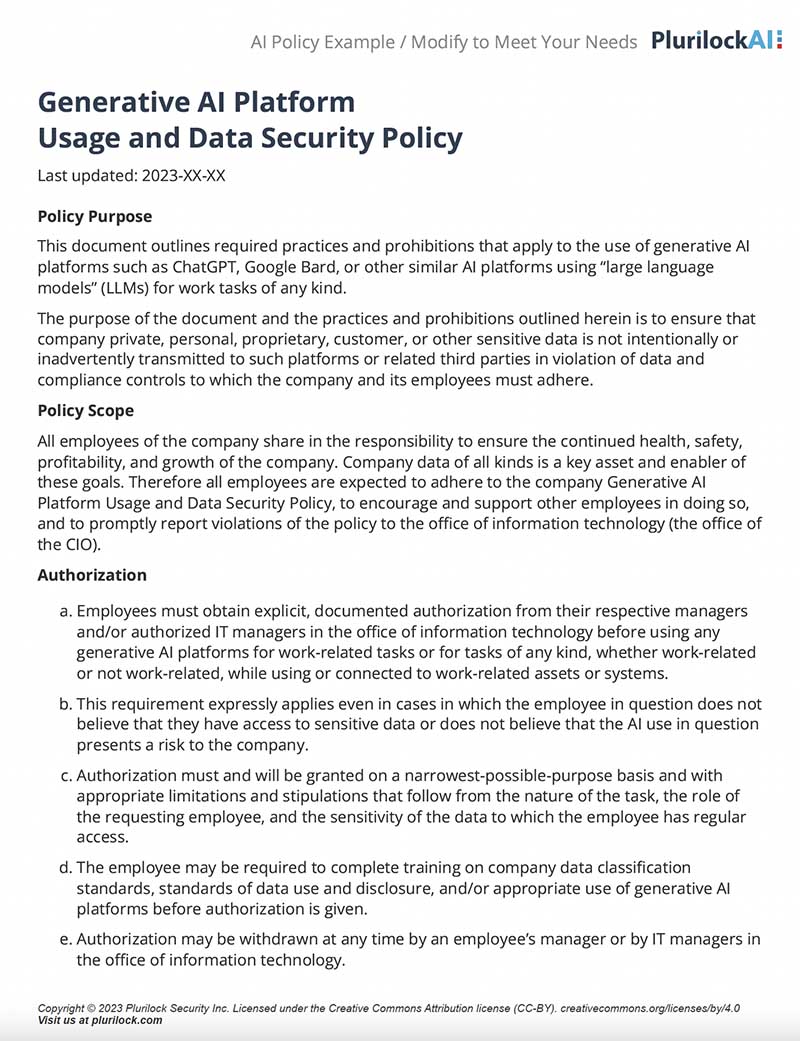
Sample Governance Policy for AI Use
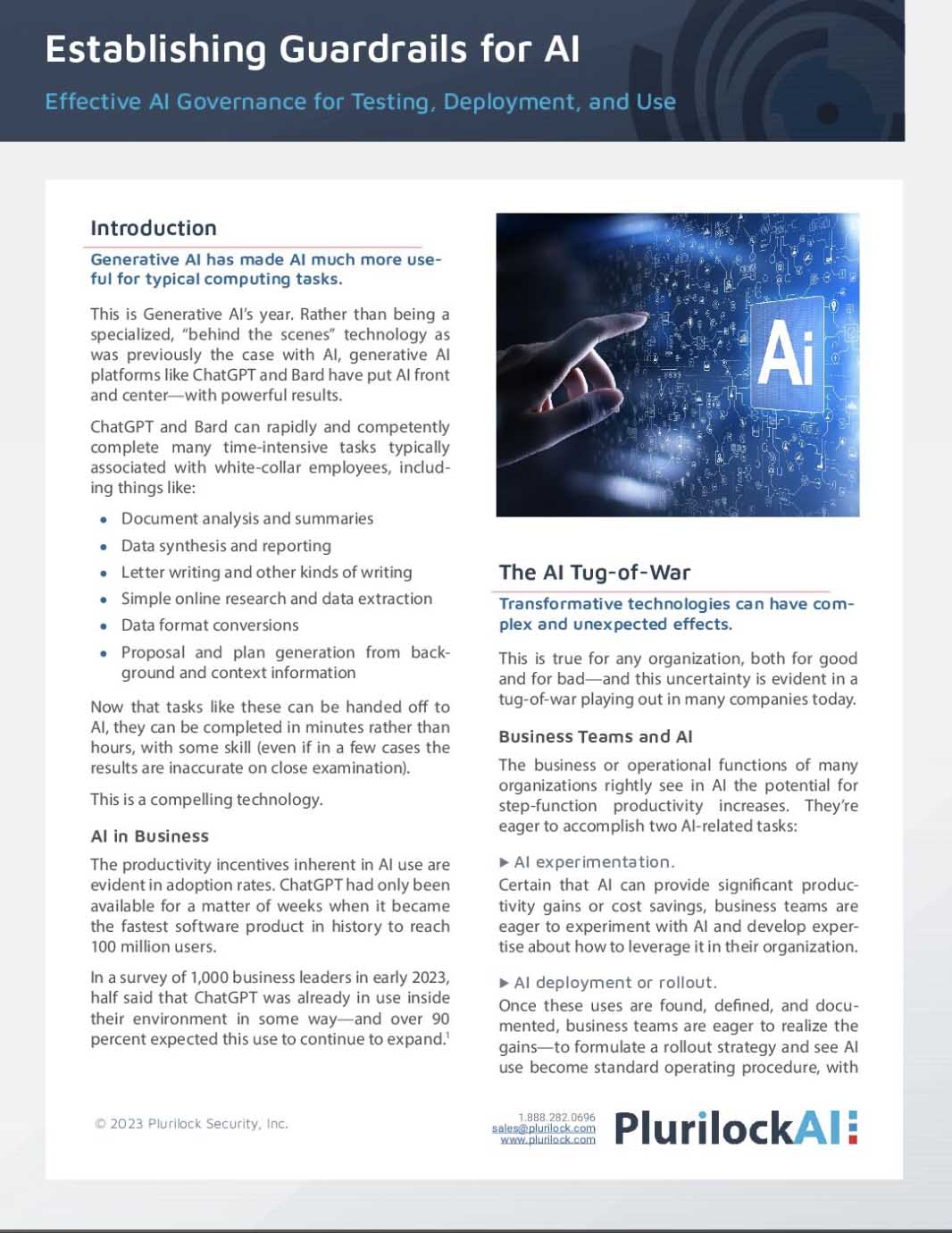
Establishing Guardrails for AI Whitepaper